The Honest Truth About AI Engineering Hiring in 2026
Inbound hiring is dead. 2,000 applicants, zero signal. Here's Klysera's unfiltered take on what actually works now and why most companies are solving the wrong problem.
A few weeks ago, when the Anthropic team announced the release of Claude Cowork, my twitter timeline was flooded with people showing off how they'd used it to apply to 50 jobs in 30 minutes.
50 jobs. 30 minutes.
I remember sitting with that number, and thinking to myself “wow, this is kind of incredible”.
Because obviously, if you're an engineer trying to get hired right now, that could mean the difference between having a job or being jobless.
But if you (as a person) can apply to 50 jobs in 30 minutes, so can everyone else. Every engineer. Every candidate. Every person who has ever touched a keyboard.
And, if you're a company trying to hire one, I’d imagine most HR teams are scrambling around looking for a way to mitigate against the flood of ai-slop like applications floating into their pipeline.
While in the middle of that thought, I came across a nearly viral tweet from Gergely Oroz, where he said what most people already know- that inbound applications are dead.
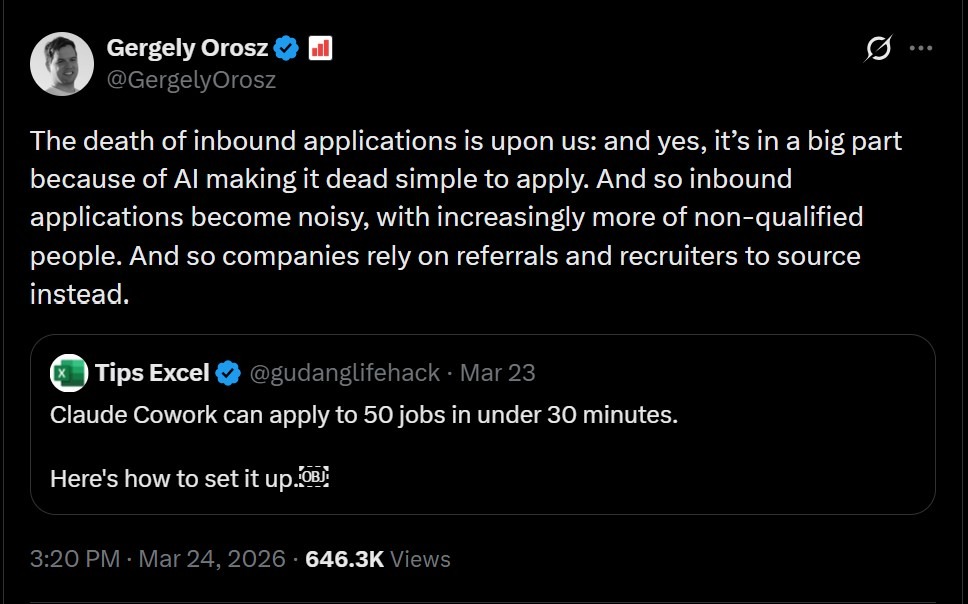
It’s not slowing down, it’s actually dead or at least comatose right now. I didn’t need to read the tweet to believe it, especially after I’d seen it myself.
To be fair, we built Klysera for this exact reason. We've known this was coming. And I'll be honest, watching the rest of the market finally see it is equal parts vindicating and exhausting."
Exhausted watching companies hire wrong, call it a process, and act surprised when it didn't work.
So why exactly is this such a big issue now?
The Symptom Everyone's Pointing At Is Not the Disease
Everyone is pointing at AI-generated resumes/applications like that's the problem.
In my opinion, it's not. Here's what's actually happening.
For years, long before Claude Cowork, long before any of this, hiring was already measuring the wrong things.
- A "good resume" just meant someone knew how to write well, with the right words, and the right packaging.
- A strong interview meant someone could perform well under pressure that had nothing to do with actual work.
But none of that told you whether they could own a problem end to end. None of it told you whether they'd still be figuring it out six months later when things got hard.
AI didn't break engineering hiring in 2026. It just made the cracks too big to ignore.
A hiring manager I came across on Twitter — @davidecxdd — posted something to this effect. They had spent 2 weeks on an open role for an AI Engineer, even though they had over 2,000 applicants, and all of them came with perfect resumes. His conclusion was that old hiring systems don't work anymore.
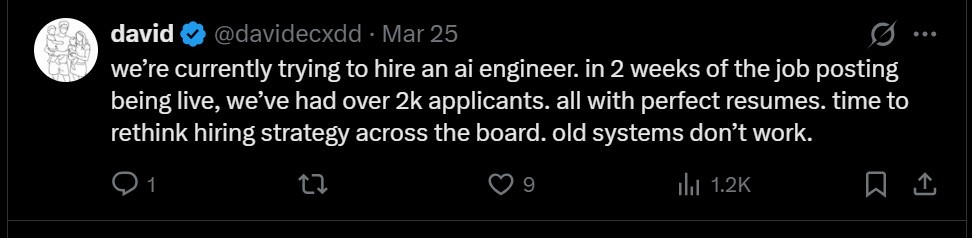
But I'd go further than that.
The old systems were never really working. We were just moving slowly enough that nobody had to admit it. The signal was always weak. AI just turned the noise all the way up.
Rather than think of this as a resume problem, I like to think of it as a trust problem. And trust, once broken at this scale, doesn't come back on its own.
So what are companies doing about it?
Well……. The Fixes Are Mostly More Theater
So what are companies doing?
Most are reaching for the obvious things:
- More screening rounds.
- Stricter filters.
- AI-powered ATS tools to sort through the AI-generated applications flooding their pipeline. Some are quietly abandoning job boards altogether and falling back on referral networks.
And honestly? I get it. When everything looks the same, you scramble for anything that feels like control.
But here's the problem with each of these.
- More screening rounds just filter for people who are good at screening rounds. Not people who can own the product from end-to-end.
- AI tools screening AI applications is the most expensive loop in hiring right now. Nobody wins except the vendors selling both sides of it.
- Referral networks work, until they don't. Your network can only stretch so wide.
Let’s not even focus on the fact that many of these so-called AI screening tools out there, will filter out the actual good candidates, because well… Ai does not yet understand nuance.And so you’re left with status-quo, picture perfect applicants who fit the job on paper but not it product mindset or ownership thinking.
Speaking of, there was a story that went viral around this time. It was a startup called RentAHuman, which supposedly let AI agents hire actual humans to do tasks the AI couldn't physically do. People lost their minds over it. Turns out, according to an investigation by German newspaper Die Zeit, not a single job had actually been arranged through the platform.

But what I found interesting, or perhaps non-interestingly is the panic people felt, the anxiety of losing track of the hiring process. Do we fix the loop? Or do we reinvent it?
So What Actually Works? Here's What We Believe.
For us, the answer was obvious. You reinvent it. Perhaps “reshaping” is the right word to use here.
When we were building Klysera, we spent a long time sitting with one uncomfortable question. If the resume is dead, the interview is gameable, and the portfolio is performative, what's actually left? What genuinely predicts whether an engineer will take ownership of a hard problem and see it through to the end?
We kept coming back to five things. And no, it wasn’t credentials, or years of experience or the right school on a shiny new CV. It was:
- Can they hold the full picture of a problem, rather than just a slice of it?
- Do they understand fundamentals deeply enough that when AI gives them a wrong answer, they know it's wrong?
- Do they build things people actually use or just things that technically work?
- Do they use AI to go further without letting AI do their thinking for them?
- Are they measurably better than they were six months ago?
This is what we vet for at Klysera. This is what our entire process is built around. And this is what we stake our fees on because we don't get paid until the engineer we place is actually delivering results.
In my opinion, these are the only five questions that matter right now in AI engineering hiring.
And here's why.
Dario Amodei, CEO of Anthropic, the same people who built Claude Cowork, said very recently that coding jobs will disappear within a year. It’s a bold and very scary claim, depending on where you sit.
But Anthropic is still hiring dozens of engineers right now.
Because at the end of the day, someone still has to own what AI produces in production. Someone still has to know when the AI is wrong. Someone still has to care whether the thing actually works for the person using it.
That someone is rare. And rare things require different methods to find them.
Why We Tied Our Revenue to Your Outcomes
Most recruiting firms charge you for a process, but we charge you only when we give you the results agreed upon.
And I want to be clear, this is not just out pricing model at Klysera. It’s one of our core values. It's us saying, plainly, that we don't think we've done anything worth paying for until the engineer we placed is actually delivering.
If we can't find someone who does that, we don't get paid. It’s really as simple as that.
And honestly? That changes everything about how we operate.
- It changes who we put forward.
- It changes who we don't.
- It means we have skin in the same game you do.
In a market where trust has completely collapsed and where 2,000 resumes tell you nothing, where every cover letter sounds identical, where the best candidate might have used the exact same AI tool as the worst one, the only honest thing you can offer is accountability to the outcome. Everything else is just noise dressed up as process.
We're not selling speed, or volume and we’re definitely not selling you a shortcut through a broken system. What we are selling is certainty in a market that unfortunately has run out of it
And look, I'll say this plainly.
The companies that will figure out how to hire software engineers in 2026 aren't the ones with the most sophisticated ATS. They're not the ones running candidates through six screening rounds. They're the ones who stopped treating hiring like a funnel and started treating it like a bet, and found someone (aka Klysera) willing to share the risk.
The Market Has Sorted Itself. Which Side Are You On?
The market moved faster than anyone expected.
On one side: companies are still processing volume, still hoping that if they screen enough, filter enough, run enough rounds, the right person will eventually emerge from the pile.
On the other we have companies that looked at the pile and said no thank you.
We built Klysera for the second group.
If you're still trying to fix your inbound hiring process, genuinely, good luck. If you've accepted that inbound is gone, and you need something that was actually built for this moment, that's exactly the conversation we exist for.
The resume isn't coming back. The question is what you're going to trust instead.
And look, after all of this, it would almost be weird if I didn't ask you to come see what we do at Klysera.
Not just see. Experience it.
There’s honestly no request too strange or too specific. Just get on a call with us, tell us exactly what you're trying to build, and we'll show you whether we can make good on everything I just said.
If we can't, we'll tell you that too. DM me directly, or drop your details below. Let's talk.


Engineering Hiring Intelligence. Fortnightly.
The hiring signals, research findings, and founder insights that actually matter - delivered to your inbox every two weeks.
You Can Unsubcribe At Anytime.